Session Overview
As a leadership facilitator and executive coach, I recently delivered a session to help managers and leaders navigate the emotional and professional challenges following a reduction in force (RIF) at their organization. The session coupled William Bridge’s model of transitioning through change with Sparq, a visual reflection platform, to guide leaders through their transition journey. This work was particularly critical because all participants were people leaders and they needed to understand and process their own experience which would enable them to better directly support their teams in transitioning through the same turbulent period.
The Sparq Approach
Sparq helps individuals and groups better understand themselves and others through visual reflection. Rather than relying solely on written or verbal expression, participants select images that resonate with their emotional state and experiences, making the reflection process more accessible and often more authentic. This visual methodology helps people tap into feelings and perspectives they might struggle to articulate through words alone.
Session Design: "From, Here, to There"
The session was structured around three critical reflection questions aligned with Bridges' transition model:
FROM: How did you feel at the start of this change journey?
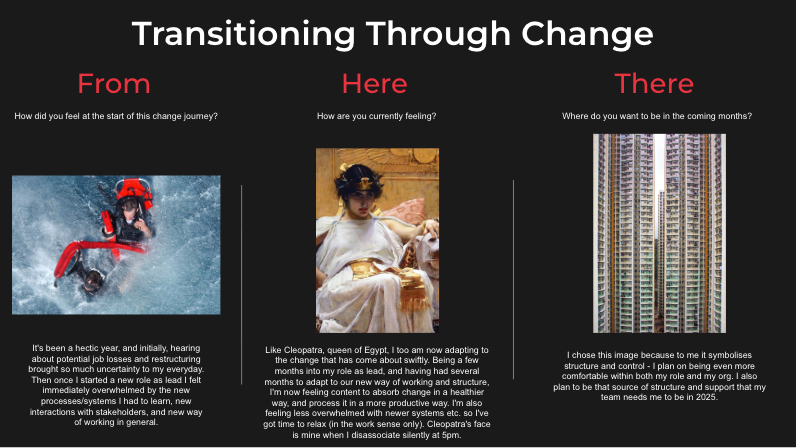
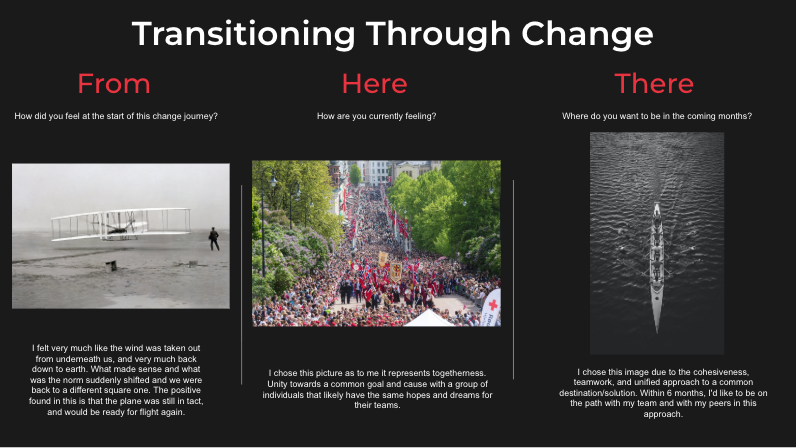
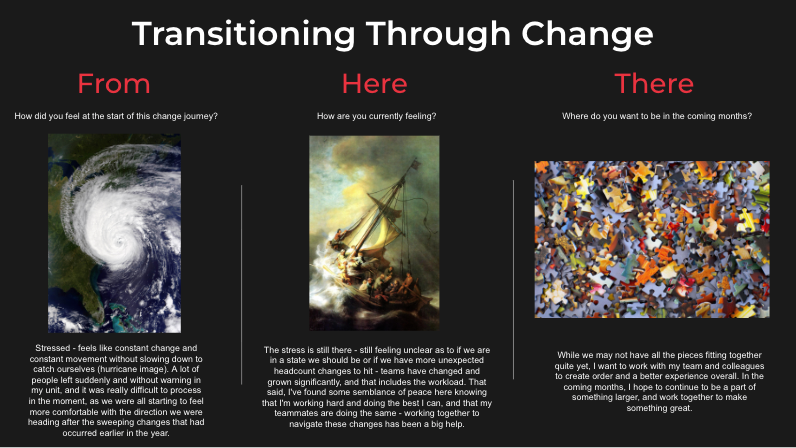
Leaders described feeling overwhelmed, uncertain, and destabilized. Common themes included the "hurricane" of constant change, feeling like "the wind was taken out from underneath us," and the immediate stress of learning new systems while processing unexpected departures of colleagues. One leader shared feeling the weight of "so much uncertainty" in their everyday life while simultaneously taking on new leadership responsibilities.
HERE: How are you currently feeling?
Participants revealed they were in various stages of adaptation. Some had found their footing, describing themselves as "adapting like Cleopatra" and feeling less overwhelmed. Others remained stressed but had found "semblance of peace" through teamwork and collective resilience. The visual reflection helped normalize these varied experiences and revealed the common thread of togetherness and unity that was sustaining them.
THERE: Where do you want to be in the coming months?
Leaders expressed aspirations centered on structure, unity, and collective success. Images chosen represented cohesiveness, puzzle pieces fitting together, and working toward common goals. Notably, they wanted to become sources of "structure and support" that their teams needed, working collaboratively to "create order and a better experience overall."
Impact: From Self-Awareness to Team Leadership
The transformative power of this Sparq exercise lay in how it helped people leaders better understand their own journey, which in turn enabled them to more effectively support their teams. By naming and visualizing their own emotions, from initial overwhelm to gradual adaptation, leaders gained critical insight into what their team members were likely experiencing. They recognized that if they, as leaders, felt destabilized and stressed, their teams were undoubtedly processing similar emotions.
This self-awareness created a foundation for empathy and intentional leadership. Leaders who acknowledged they were still "working together to navigate these changes" could approach their teams with authenticity rather than false confidence. Those who recognized their own need for structure and clarity understood why their teams craved the same. The visual nature of Sparq made these insights visceral and memorable, creating shared language and understanding across the leadership cohort.
Outcomes
The Sparq platform enabled leaders to process their experiences in a psychologically safe environment while viewing peers' reflections, reducing isolation and building collective resilience. By mapping their journey through Bridges' transition model, leaders didn't just gain perspective on their own progress, they developed a roadmap for guiding their teams. They left the session with clearer intentions about being the stabilizing presence their teams needed, understanding that effective change leadership begins with honest self-reflection and genuine understanding of the human experience of transition.